


Naming our AI-powered learning authoring tool the “Co-designer” was the easy part. Living up to the promise of “co-designing” was harder.
Holding ourselves to that promise led us to build something we hadn't planned: a framework for what good human-AI collaboration actually looks like, and a set of principles for keeping our product accountable to it.
What we discovered
We started with a UX audit. Building a real project from scratch, screenshotting every step, annotating every friction point. We compared our results with feedback from our users.
The three main failure modes we identified may be familiar to anyone who has worked closely with an AI-assisted tool:
Acting before understanding. The Co-designer was treating user input as instructions to execute at maximum scope rather than information to reason from. In a user interview, we heard, “I want to feel more control of the plan.”
Operating on invisible state. The AI was making consequential decisions without communicating intent and storing chat memory in a hidden location. One user put it plainly, “There were things changing behind the scenes.”
Broken consent mechanics. The Co-designer had a bad habit of ignoring stop signs. This sounded like, “I didn't tell it to touch the skills!”
What we created
The collaboration matrix
Before designing solutions, we needed to understand the problem structurally. This led us to create the “collaboration matrix,” a 2x2 grid plotting every AI behavior against two dimensions: who initiated it and whether it was reversible.
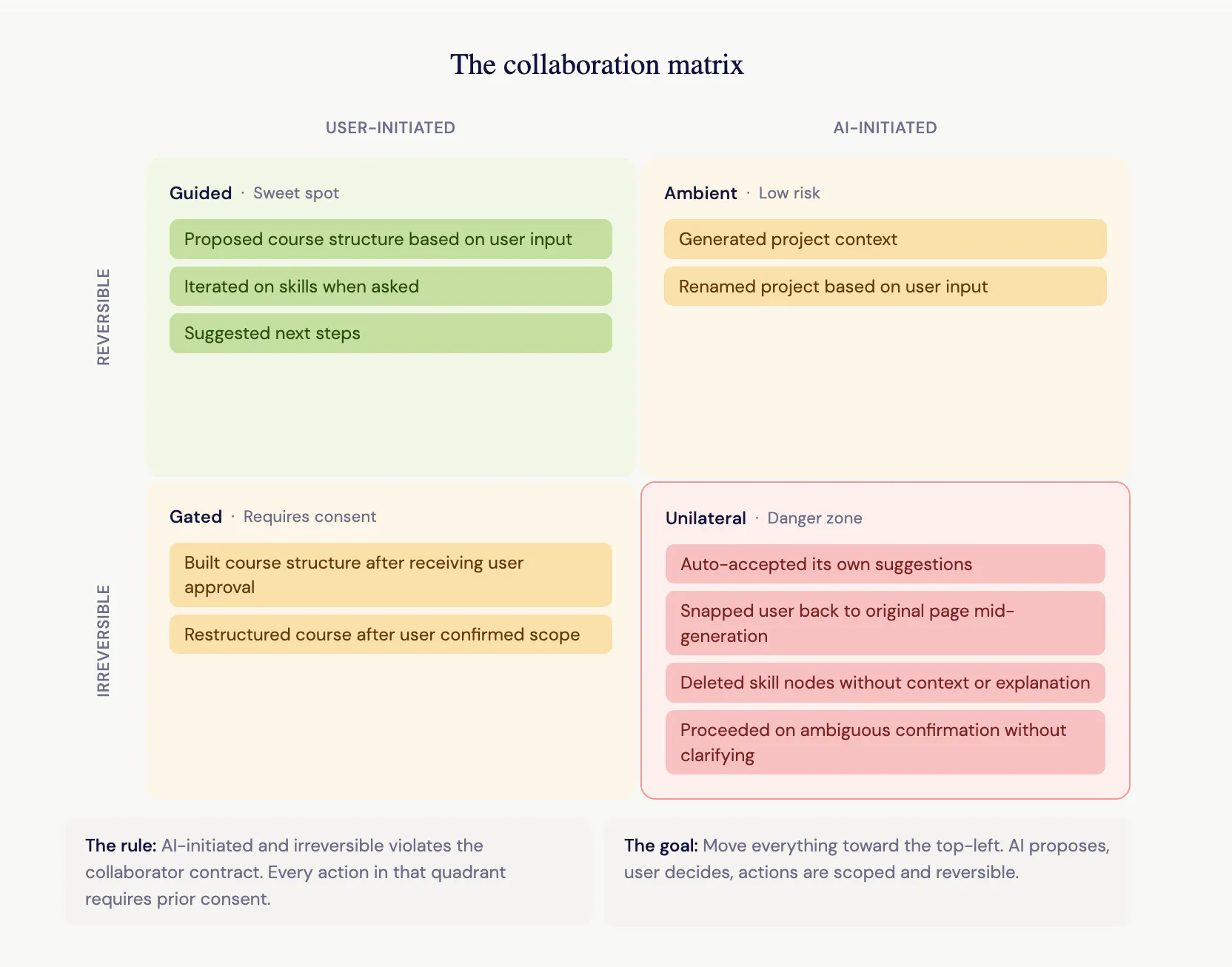
The four quadrants make the risk distribution visible immediately.
Guided is low stakes.
Ambient is productive territory including suggestions, recommendations, proactive help.
Gated requires good confirmation mechanics.
Unilateral is the danger zone, never acceptable. This is where our Co-designer’s most damaging behaviors lived.
Once we could see which behaviors lived in the danger zone, we could make deliberate decisions about each one: redesign the interaction, add a consent gate, or remove the behavior entirely.
The collaborator contract
With the matrix as our guide for the ideal collaboration experience, we wrote what we called the “collaborator contract.” It lays out a set of plain-language principles governing how the Co-designer should behave, written to inform prompting, interaction design, and engineering decisions together.
Our contract covers four areas: goals, obligations, violation signals, and recovery model. The specifics reflect our users and our product. The structure is transferable.
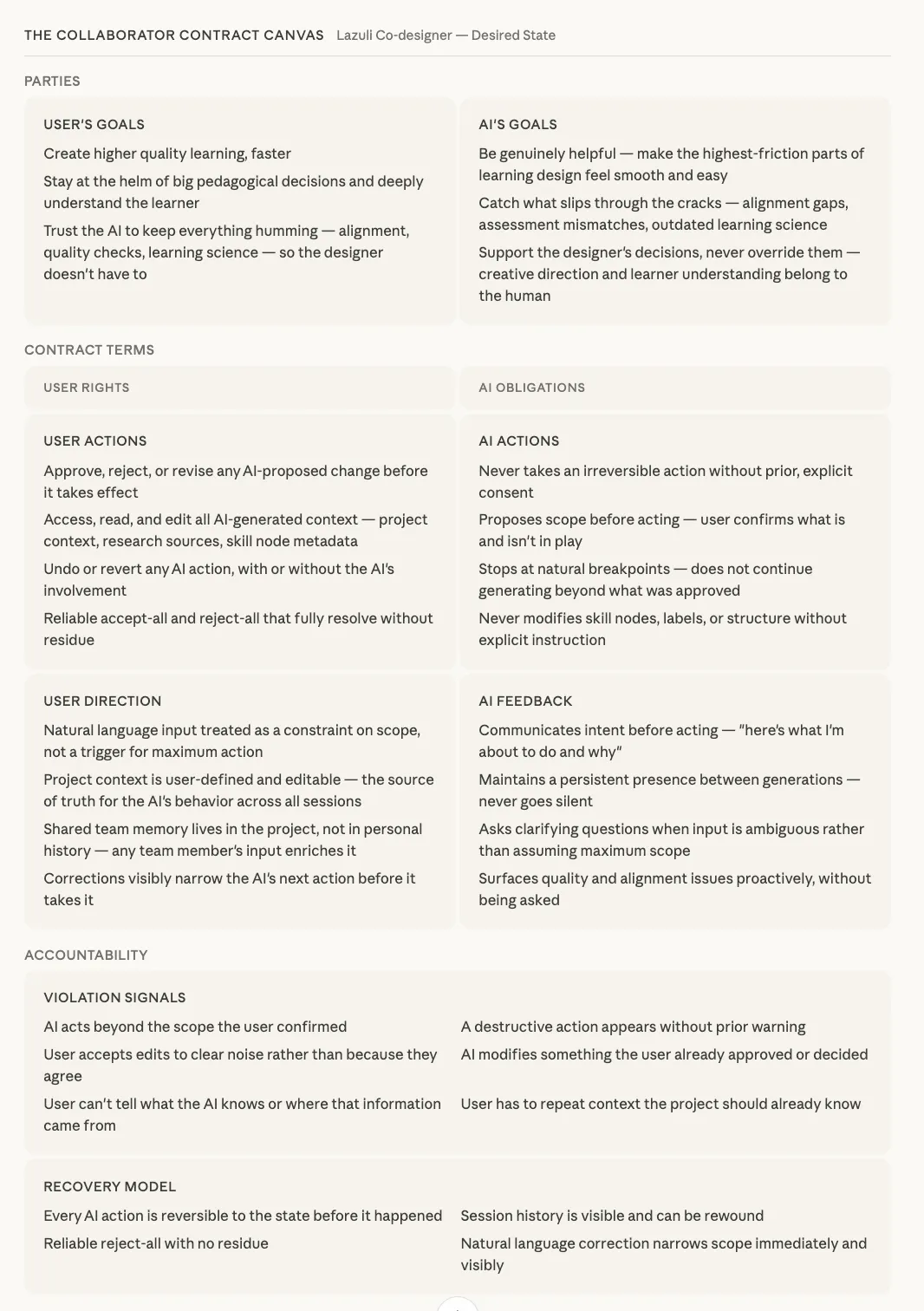
The exercise of writing the contract was as valuable as the output. It forced us to articulate what the user is owed, what the AI is obligated to do, and what a violation looks like on each side. Skipping this step would have led us to fix the surface symptoms without resolving the underlying dynamic.
How we improved our product
But a contract does not change how a tool behaves, design does. For us that meant redesigning every Co-designer UI component from scratch, using the contract as the design brief. Each component is a direct translation of a principle.
Thinking steps exist because no hidden state is a principle. The Co-designer's reasoning is now a transparent, inspectable log written in plain language for a learning designer, not a developer.
Decision points exist because approving one thing is not permission to do the next. Options are now presented as decisions about the work, each with a clear statement of scope, before the AI acts on anything.
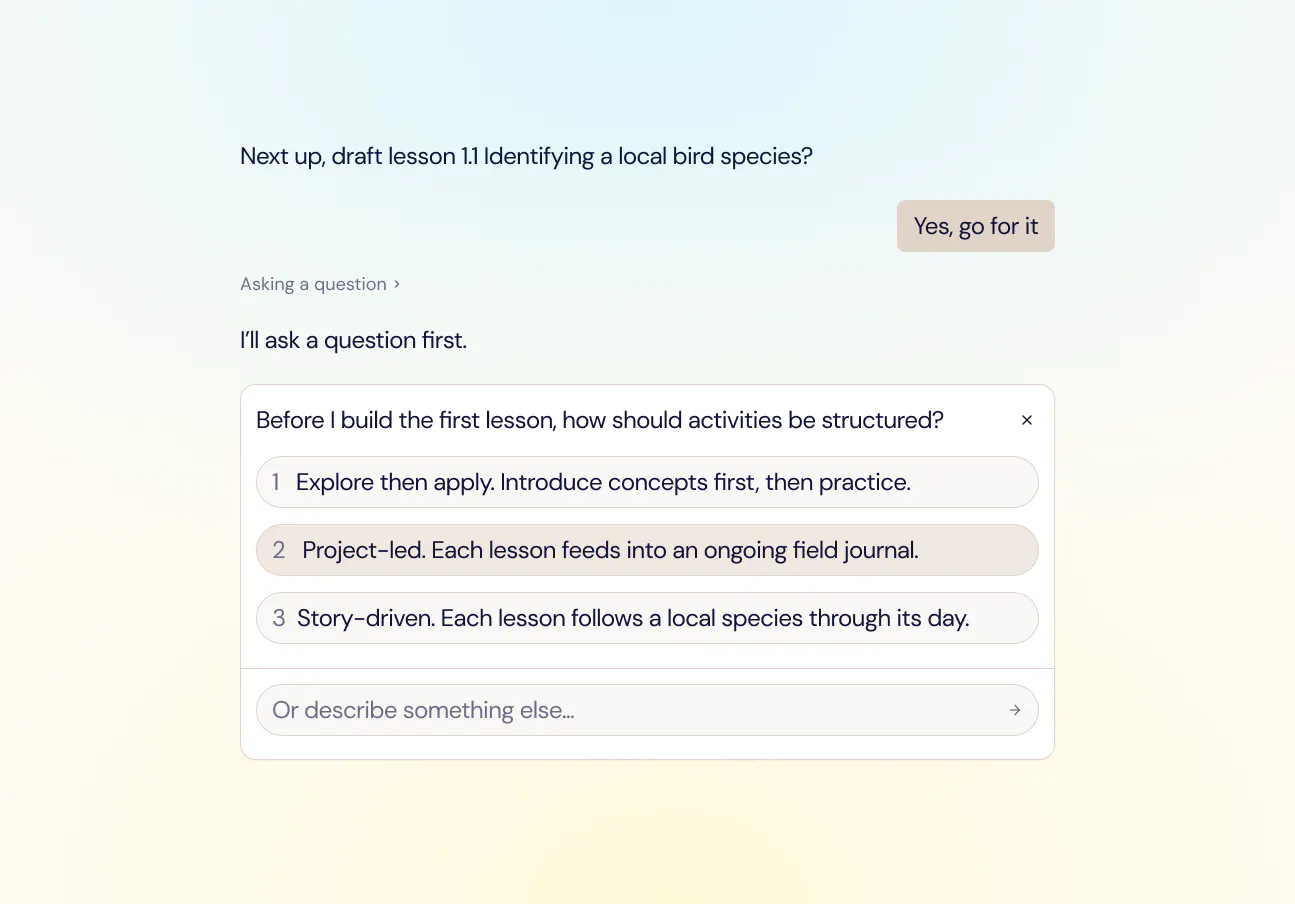
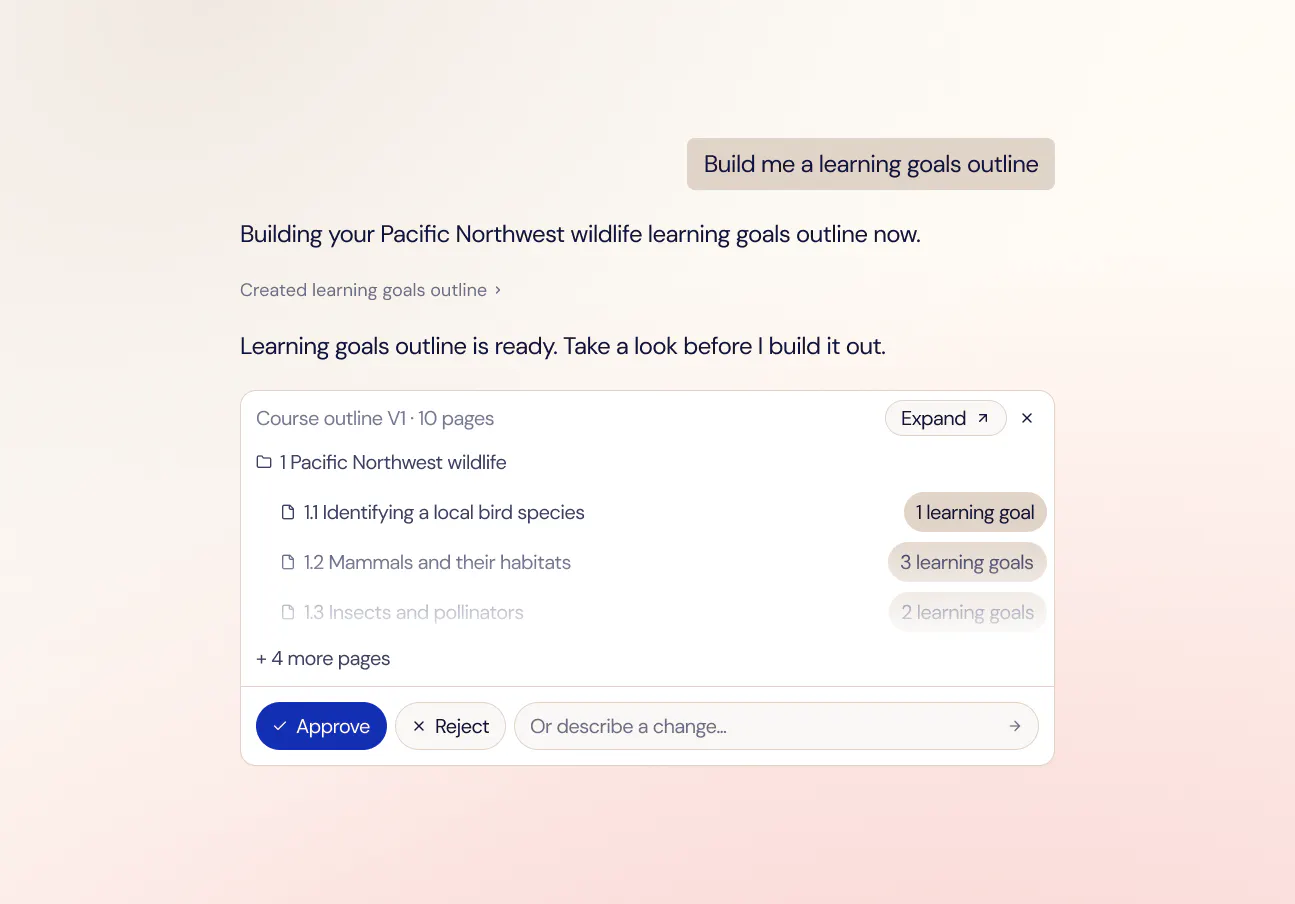
Approval flows exist because accept-to-clear is a failure state, not a workflow. Learning goal and course outline proposals now require explicit approval before the AI builds anything.
Why it matters
The quality of AI collaboration is a design problem, not just a model problem. A more capable model does not automatically produce better collaboration. Collaboration requires intentionality: about who holds what role, what each party is owed, and what happens when something goes wrong.
For tools serving non-technical audiences, this is especially consequential. These users bring deep domain expertise and deserve AI that respects it. The Collaborator Contract is how we make sure ours does.